Movie Review: Star Trek Into Darkness

Star Trek Into DarknessTitle: “Star Trek Into Darkness”

Director: J.J. Abrams

Writer: Roberto Orci, Alex Kurtzman, Damon Lindelof, Gene Roddenberry (created by)

Starring: Chris Pine, Zachary Quinto, Zoe Saldana

My rating: 2 out of 5 stars

Again, this is a movie that I came into with a lot of bias. I enjoyed the old “Star Trek” television series and the movies (well, some of the movies). If there was one movie that had so much potential yet became such a letdown, it was “Star Trek Into Darkness.”

The previous “Star Trek” was enjoyable and exciting, even if it wasn’t perfect. As a reboot of the franchise, I give the filmmakers credit for having made the reboot part of the plot rather than just saying, “This is what we’re doing now because we say so. Deal with it!” For those who don’t know, the previous movie involved a time travel plot that altered the past and created a new timeline, so everything is now new and has an in-movie explanation for being different from the original series. Which was the reason that “Star Trek Into Darkness” was so disappointing.

In this film, the Federation is dealing with a terrorist who seems to know all their military and security secrets and is bent on their destruction. How this ultimately plays out will cause the audience to ask what the point of the reboot was. All this movie did was recycle old plots and characters from the original timeline, so much so that it amounts to little more than lazy writing and a lack of imagination. With a whole new world opened up through the reboot, why did they feel the need to go back to old plotlines?

It gets worse. Not only are old plots recycled, but old scenes are recycled. But they’re not just recycled. They are altered just enough that it’s not just retreading old stories, but parodying them. In what was supposed to be a particularly serious scene, people in the audience were laughing because the way the scene was recreated was ridiculous. And the deus ex machina ending will leave the audience shaking their head. Handwavium seems to have survived to this timeline.

Admittedly, the movie does have some good action and decent special effects, but not much we haven’t seen in the previous movie (aside from the neat effect of a Starship crashing into San Francisco; that was nicely done). If you haven’t seen any of the old Star Trek series or movies, this might be a bit more enjoyable, but if you know anything at all about the old series, this movie becomes a bit of a groaner.

This makes me more than a little concerned for J.J. Abrams’ take on “Star Wars.”

“Star Trek Into Darkness” earns 2 out of 5 stars.
Movie Review: The Invisible Woman

The Invisible WomanTitle: “The Invisible Woman”

Director: Ralph Fiennes

Writer: Abi Morgan

Starring: Ralph Fiennes, Felicity Jones, Kristin Scott Thomas

My rating: 2.5 out of 5 stars

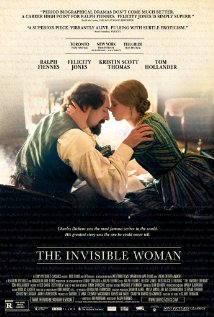
Based on Claire Tomalin’s book of the same name, “The Invisible Woman” follows the story of Nelly Ternan, the woman who became Charles Dickens’ secret mistress. Told in a series of flashbacks, we see Nelly as she meets Dickens during the height of his career and follow their relationship (and his relationship with his wife) up until his death.

Many will probably find this movie rather dull and not without cause. Much of the drama in this movie, with the exception of a couple of scenes, feels a bit forced, as if the filmmakers needed standing there telling the audience that they’re now supposed to feel tension, now they’re supposed to feel sad, and so on. But ultimately, it doesn’t feel terribly natural.

The performances are quite good. Ralph Fiennes portrays Charles Dickens as a light-hearted and flamboyant writer and actor, as well as a man who saw little use for Victorian convention. Felicity Jones plays Nelly beautifully, with a youthful wonder and enchantment of an already established and famous Dickens. She also portrays Nelly as being very caught up in Victorian morals and a desire to remain within the bounds of what is socially acceptable.

This is where most of the drama comes from. It’s not necessarily a conflict between characters, where, as I said before, the drama feels forced. Most of the conflict comes when the principals find themselves in conflict with Victorian social norms, particularly regarding marriage and sex. It’s drama that acts as an undercurrent, and never fully manages to break the film’s surface, but it’s there if you pay careful attention.

The costuming (for which this film is nominated for an Academy Award) and the set design are quite good. Well, the set design is when you can see it. Many scenes in the movie are very dark. I don’t mean that in terms of tone. I’m actually referring to the lighting. Ambient lighting can sometimes be a problem with this movie. While theses scenes do take place at night, there’s still something to be said for visual quality over authenticity at times, especially when a movie is slow with understated drama. You risk putting your audience to sleep.

Ultimately, “The Invisible Woman” is passable. It’s not really bad, but it’s not really that good, either. It’s one of those movies that’s just kind of there. While it has wonderful performances and great costuming, it suffers from understated and at times forced drama and low lighting that make the film feel slow and frustrating, and it can be so slow at times that it can feel like a chore to get through. I enjoy the works of Charles Dickens, but this biopic is only okay.

“The Invisible Woman” earns 2.5 out of 5 stars.

Movie Review: The Wind Rises

The Wind RisesTitle: “The Wind Rises (Kaze Tachinu)”

Director: Hayao Miyazaki

Writer: Hayao Miyazaki

Starring (English voice cast): Joseph Gordon-Levitt, John Krasinski, Emily Blunt

My rating: 4.5 out of 5 stars

Okay, let’s start this review honestly: This is a Miyazaki film, so it’s extremely hard to come into this unbiased. “Spirited Away” is still one of my favorite films of all time, animated or not, and since Miyazaki has announced that this will be his final feature film before retiring, it’s hard to not come into this with some preconceived opinions (although Miyazaki later retracted the statement about his retirement, so who knows?).

“The Wind Rises” is quite different from Miyazki’s previous films, which use very strong fantasy elements to tell their story. This film is actually an animated biopic about Jiro Horikoshi, an aeronautical engineer who was responsible for designing the Mitsubishi A5M and A6M Zero fighter planes, which were both used by Japan during World War II.

Two things to keep in mind while watching this film is that it is a highly fictionalized biography and it’s highly stylized. Instead of fantasy elements as many of Miyazaki’s most popular films have relied on, this film uses dream sequences and stylistic wind to convey a sense of wonder and the abstract without leaving reality. Being a biopic, it’s generally a very realistic film that focuses on the major historical events that occurred during Horikoshi’s life, including the great Kanto earthquake of 1923 and the looming World War II, and how they affected the course of Horikoshi’s life and his thinking.

The film is beautiful. It’s thoughtful. It’s emotional. But it’s also not without controversy. Many will likely be upset that this film is about a man who designed machines that were used to killed thousands. The film answers this by portraying Horikoshi as a man who simply dreamed of building beautiful flying machines but was upset by their potential to be used in war., even at one point suggesting that they could lighten the aircraft’s weight by removing the guns. Whether this is true or not I couldn’t tell you and is beyond the scope of this review. But, again, this will likely cause and has caused some controversy in certain circles.

While the story of an engineer might seems dull, it’s really a story about dreams and about love and loss. It’s a story that is set firmly in the real world, based on real people and events, and shows how with big enough dreams, we can create wonders, but to guard those dreams carefully because they can just as easily be manipulated to create horrors. It could be disconcerting to watch such a realistic film by Miyazaki if the viewer is only familiar with his more fantastic works, and this film is not completely without fault, such as when one character begins to cry and water starts gushing out of her eyes, which seems out of place in a film and story so firmly based in reality. It also has a slow pace and little direct conflict outside of Horikoshi’s own mind, so the viewer to remember that this is a thoroughly artistic movie. However, with mind-blowing animation, some of the most beautiful cel drawings I have every seen, a wonderful and heartbreaking story, and a haunting soundtrack, “The Wind Rises” is a fitting swan song to one of the greatest animation writers and directors in the world.

“The Wind Rises” earns 4.5 out of 5 stars.

Movie Review: Ernest & Celestine

Ernest and CelestineTitle: “Ernest & Celestine”

Directors: Stéphane Aubier, Vincent Patar, Benjamin Renner

Writers: Gabrielle Vincent (book), Daniel Pennac (screenplay)

Starring: Forest Whitaker, Lambert Wilson, Pauline Brunner

My Rating: 4 out of 5 stars

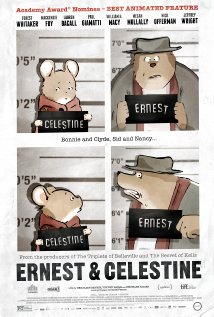
Ernest is a bear that lives on the outskirts of the city. Celestine is a mouse that lives with other mice under the city. Mice and bears don’t mix well, but when Celestine helps Ernest and gets cast out of the sewers, they both become fugitives and have to rely on each other and overcome their prejudices.

Based on a series of children’s books by Belgian author and illustrator Gabrielle Vincent, this movie is adorable. Created in a simplified hand-drawn animation style, it immediately grabs your attention with its minimalistic visuals, while at the same time painting the screen like a beautiful watercolor painting. The characters are cute and friendly for the most part. Ernest and Celestine are both endearing characters, although the secondary characters can feel two-dimensional. That’s not necessarily a bad thing with this kind of movie. The other characters are supposed to be somewhat villainous, or at least closed-minded, afterall, and it is a movie whose primary audience is children.

While the plot is simple and its moral basic, it’s still a great film for children and their parents. Overall, the message this movie contains is to avoid prejudices and that friends can be found in the most unlikely places. All around, it’s a great movie for kids and adults alike with a great mix of humor for all ages, and an ultimately life-affirming lesson. Highly recommended if you can find it.

“Ernest & Celestine” earns 4 out of 5 stars.

Movie Review: Despicable Me 2

Despicable Me 2Title: “Despicable Me 2”

Directors: Pierre Coffin, Chris Renaud

Writers: Cinco Paul, Ken Daurio

Starring: Steve Carell, Kristen Wiig, Benjamin Bratt

My Rating: 2.5 out of 5 stars

“Despicable Me” was a decent movie. It was different, enjoyable, and reasonably funny. “Despicable Me 2” tries to do the same thing. Almost exactly the same. In “Despicable Me 2,” Gru (voiced by Steve Carell), who is now reformed and a devoted father, is recruited by the Anti-Villain League to investigate a new potential threat.

This movie does some things better and some things worse than its predecessor. It’s not as funny or as exciting as the first movie, or have the plot twists of the first movie (even if they were fairly obvious there). The one main plot twist in this movie is so blatantly obvious from the beginning that there’s no opportunity to even fake surprise. Overall, the plot is rather dull and predictable, relying on a string of jokes to move the film along.

The jokes are simplified from the first movie, so dumbed down that they’re more groaners than anything else. The minions’ role is increased, which is actually good. They were show-stealers in the first movie, and continue to be here. The voice acting is quite good, too, and Steve Carell really tries to sell Gru. But this movie ultimately feels like it was a quick cash-in to try to follow the success of the first movie as quickly as possible.

“Despicable Me 2” earns 2.5 out of 5 stars.